Blog
Sur-Ron Light Bee X vs Ultra Bee: Which One Should You Buy?
Jun
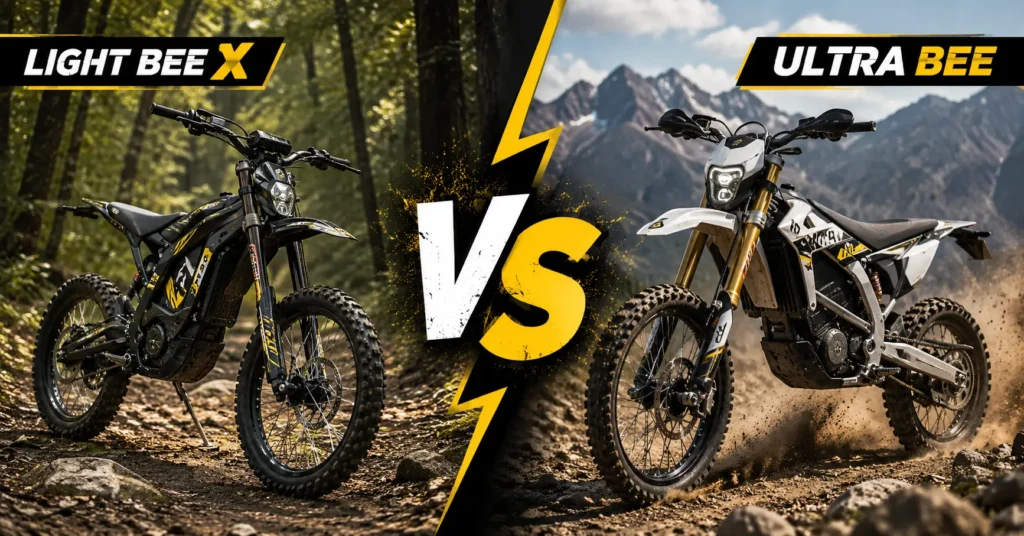
Two electric dirt bikes. One brand. Completely different riding experiences.
Sur-Ron built its reputation on the Surron Light Bee X a lightweight, nimble machine that turned the electric off-road world upside down. Then they dropped the Sur Ron Ultra Bee, a full-size electric dirt bike with nearly double the power and a chassis that finally suits adult riders. Now you’re standing between the two, wallet in hand, and the question is simple: which one is actually right for you?
This guide cuts through the spec sheet noise. We’ve analyzed what competitors get wrong about this comparison and we’re giving you the real-world breakdown that helps you make a confident decision.
Quick Verdict: Who Each Bike Is For
Buy the Surron Light Bee X if:
- You’re under 5’10” or weigh under 180 lbs
- You’re new to electric dirt bikes or returning to riding after a break
- You ride tight technical trails, urban areas, or backyard tracks
- You want something easy to transport and pick up after a drop
- Budget matters and you want the deepest aftermarket parts ecosystem available
Buy the Sur Ron Ultra Bee (HP) if:
- You’re a seasoned rider who came up on gas bikes like a 250cc or 450
- You’re 5’11” or taller and want full-size dirt bike geometry
- You ride aggressive terrain — MX tracks, enduro loops, steep hill climbs
- Range is non-negotiable and you want to ride all day
- You’re ready to invest in the most powerful Surron on the market
The truth? Most buyers who pick the wrong bike do so because they buy on paper specs rather than on riding style. This guide fixes that.
Side-by-Side Spec Comparison Table
| Spec | Sur-Ron Light Bee X | Sur Ron Ultra Bee HP (2025) |
| Motor Type | Mid-drive PMSM | Hairpin PMSM |
| Peak Power | 8 kW (~10.7 hp) | 21 kW (~28.2 hp) in Turbo |
| Continuous Power | 6 kW | 18 kW (Sport Mode) |
| Wheel Torque | ~196 lb-ft | ~377 lb-ft |
| Battery | 60V / 40Ah (2.4 kWh) | 74V / 60Ah (4.44 kWh) |
| Top Speed | ~47 mph (75 km/h) | ~59 mph (95 km/h) |
| 0–31 mph | ~4 seconds | ~2 seconds |
| Weight | ~121 lbs (55 kg) | ~195 lbs (88.5 kg) |
| Seat Height | ~29.5 in | ~35.8 in |
| Suspension Travel (F/R) | ~8 in / ~8 in | ~9.4 in / ~9.4 in |
| Wheel Size | 19″ F / 16″ R | 19″ F / 18″ R |
| Drive System | Belt + chain | Primary belt + chain |
| Charge Time | 2.5–3.5 hours | ~4 hours (0–100%) |
| Real-World Range | 40–60 miles (trail riding) | 60–71 miles |
| Riding Modes | Eco, Daily, Sport | Eco, Daily, Sport, Track, Turbo, Reverse |
| Traction Control | No | Yes (SRTC, 3 levels) |
| ABS | No | No |
| Price (2025) | ~$3,099–$4,000 | ~$5,499–$6,499 |
Note: The 2025 Ultra Bee HP represents a massive 68% power jump over the previous 12.5 kW model. If you’re comparing to an older Ultra Bee review, these numbers are not the same bike.
Power & Performance: Light Bee X Breakdown
The surron light bee x doesn’t win on raw numbers it wins on feel.
The 2025 Light Bee X runs an 8 kW peak mid-drive motor on a 60V/40Ah battery (a meaningful upgrade from the older 6 kW / 32Ah setup). On paper, 10.7 horsepower sounds modest. On the trail, it feels like twice that. Electric torque hits at zero RPM, which means every twist of the throttle delivers an immediate, linear response—no clutch, no rev-matching, no lag.
The power delivery on the LBX is forgiving. You can open the throttle mid-corner without the back end snapping out. In tight, rooty singletrack where momentum control matters more than peak acceleration, this bike excels. Experienced MTB riders picking up their first e-moto almost always say the same thing: it feels like a superpower.
Three riding modes — Eco, Daily, and Sport — let you tune the character. Eco extends range and softens throttle response, which makes it ideal if younger family members share the bike. Sport mode unleashes the full 8 kW and pushes the top speed toward 47 mph on flat ground.
Where the LBX loses ground is on long straights, steep hill climbs with a heavier rider aboard, and high-speed MX sections where you want more grunt. It doesn’t run out of fun — it runs out of horsepower in those specific situations. That’s the moment riders who outgrow it know it’s time to look at the Ultra Bee.
Key Light Bee X performance takeaways:
- Best power-to-weight ratio in the Surron lineup
- Linear, controllable throttle — great for skill development
- 2025 battery upgrade reduces voltage sag under hard aftermarket controller loads
- Climbs grades exceeding 45 degrees despite modest output
- Top speed electronically limited; aftermarket controllers can push it further
Power & Performance: Ultra Bee Breakdown
The Surron Ultra Bee HP is a different conversation entirely.
The 2025 model uses Sur-Ron’s new Hairpin PMSM motor a technology borrowed from higher-output applications that improves slot fill factor, heat dissipation, and torque density. The result: 18 kW continuous in Sport mode, with a Turbo burst mode that spikes to 21 kW. That translates to 377 lb-ft of wheel torque and a 0–31 mph time of two seconds flat.
Former Supercross winner Josh Hill runs a modified 2025 Ultra Bee HP in Arenacross competition. Ultra Bees made up more than half the field at the 2024 Red Bull Tennessee Knockout eMoto class, with top riders posting times comparable to the fastest amateur-class gas bike competitors. That’s the level we’re talking about.
But here’s what most comparison articles miss: the Turbo mode on the 2025 Ultra Bee HP is genuinely too much for most riders. Cycle News testers noted that the 10-second turbo burst can cut power precisely when you need it on a climb or exit, creating control issues at the chassis limits. Sport mode — 18 kW sustained — is where experienced riders spend 90% of their time. Turbo is a party trick.
The five riding modes (Eco, Daily, Sport, Track, Turbo) plus Reverse give you a truly programmable machine. Traction control (SRTC) with three adjustable levels is a genuine game-changer for wet or loose conditions — a feature the Light Bee X simply doesn’t offer.
The Ultra Bee’s throttle snaps forward where the LBX builds gradually. On a tight technical trail, that snap demands respect. On an open MX track or fast enduro loop, it’s exactly what you want.
Key Ultra Bee HP performance takeaways:
- 68% power increase over the previous 12.5 kW Ultra Bee — these are not the same bike
- Adjustable traction control makes it more accessible than raw numbers suggest
- Turbo mode is effective but has a 10-second duration limit — use it strategically
- Reverse mode is genuinely useful on technical terrain
- Approaches the performance of a 250cc four-stroke gas dirt bike
Range, Battery and Charging Compared
Battery range is where these two bikes diverge most in practical daily use, and most buyers underestimate how much this matters until they’re 40 minutes into a trail session watching the gauge drop.
Light Bee X Battery: The 2025 model upgraded to a 60V/40Ah (2.4 kWh) pack, up from the older 32Ah unit. In real-world trail riding, expect 40–60 miles depending on terrain aggression and rider weight. Hard MX-style riding will cut that to 45–60 minutes of continuous seat time. Charging from empty takes 2.5 to 3.5 hours on a standard outlet — the fastest in the Surron lineup. The smaller, lighter battery is a direct contributor to the bike’s 121 lb dry weight.
Ultra Bee HP Battery: The 74V/60Ah (4.44 kWh) pack is nearly double the capacity. Real-world range sits at 60–71 miles under aggressive riding conditions, and casual trail riders or commuters can push closer to 90+ miles in Eco mode. Charging takes approximately four hours from 0–100%. The fast-charge capability (2.5 hours to 80%) is a practical upgrade for back-to-back riding days. A significant advantage the Ultra Bee HP adds is under-seat charger storage — you can carry your charger without a bag, which changes how you plan longer rides.
Head-to-Head Reality: If you ride 1–2 hour sessions and return to a charger, both bikes cover you. If you run full-day trail sessions, enduro events, or multi-stop rides, the Ultra Bee HP’s larger pack is the clear choice. The LBX’s faster charge time partially offsets its smaller range — bring the charger, find an outlet at lunch, and you’re back to full in under three hours.
Internal link opportunity: See our full guide to [electric dirt bike range and battery care] for tips on extending pack life through proper charging habits.
Weight, Handling and Trail Feel
This is where most buyers make their final decision — and where most competitor articles stop at “the LBX is lighter.”
The 74-pound weight gap between the LBX (121 lbs) and the Ultra Bee HP (195 lbs) isn’t just a number. It defines two completely different riding experiences.
Light Bee X trail feel: The LBX flicks through corners the way a high-end mountain bike does. Its low seat height (29.5 inches) puts both feet flat on the ground for most riders, which builds confidence fast. After a crash — and there will be crashes — you pick it up with one hand. The narrow chassis disappears beneath you on technical singletrack. Riders coming from a mountain bike background describe it as a natural evolution.
The flip side: taller riders (6’2″+) feel cramped. The stock suspension is soft and wallows in bigger hits. Bar risers and suspension upgrades are almost universally recommended by experienced LBX owners, and the aftermarket supports both easily. The bike rewards aggressive trail technique but punishes high-speed MX aggression in stock form.
Ultra Bee HP trail feel: The Ultra Bee’s geometry is dirt-bike-sized by design. The 35.8-inch seat height puts it two inches lower than most full-size off-road motorcycles, but it still requires riders to stand on tiptoe unless they’re 5’9″ or taller. The 54.3-inch wheelbase is four inches shorter than comparable gas bikes, keeping it more maneuverable than you’d expect.
At speed, the extra weight becomes an asset. The Ultra Bee plants itself on high-speed corners, absorbs chop better, and holds a line through braking bumps in a way the LBX simply cannot. The 9.4-inch suspension travel (versus the LBX’s 8 inches) also makes a meaningful difference over jumps and rock gardens.
The honest middle ground: Adult riders who’ve been on the LBX for a season consistently say the same thing — the Ultra Bee feels like a real motorcycle. The LBX, as good as it is, always feels like a high-powered pit bike. Neither is wrong; they serve different riders.
Price Difference: Is the Ultra Bee Worth the Premium?
In 2025, the Surron Light Bee X sits at $3,099–$4,000 depending on dealer and configuration. The Sur Ron Ultra Bee HP lands at $5,499–$6,499. That’s roughly a $1,500–$2,400 gap — significant money that deserves a serious answer.
The Ultra Bee premium buys you:
- 68% more peak power (21 kW vs 8 kW)
- 85% more battery capacity (4.44 kWh vs 2.4 kWh)
- 25% more suspension travel
- Traction control, Turbo mode, Reverse, and Track mode
- Full-size chassis that accommodates adult riders without ergonomic modifications
- Better resale value (demand has stayed high, supply remains limited)
Where the Light Bee X wins on value:
- Lower entry price makes it the better first electric dirt bike
- Larger, more mature aftermarket ecosystem (it’s been around longer)
- Easier to sell used — bigger buyer pool for modified builds
- Lower long-term maintenance cost due to lighter drivetrain stress
- Sufficient for the majority of trail riders who never push past its limits
The straight answer: If you’re a casual to intermediate trail rider who fits the LBX ergonomically, the extra $1,500–$2,400 does not improve your riding experience proportionally. You’ll never touch the Ultra Bee’s top end. Buy the LBX, ride it for a year, and upgrade if you outgrow it Surrons hold value well enough to make that path financially sound.
If you’re an experienced rider, ride MX tracks, carry a heavier body weight, or want the machine to grow into for the next three to five years, the Ultra Bee HP at $6,499 is a legitimate value against a comparable gas dirt bike at $8,000+ with ongoing fuel and maintenance costs.
Which Age and Skill Level Suits Each Bike?
Sur-Ron Light Bee X:
- Age: Teens (14+) and adults up to around 6’1″
- Skill Level: Beginner to intermediate — ideal as a first e-moto
- Rider Weight: Best under 180 lbs for optimal performance
- Background: Mountain bikers, casual trail riders, urban riders
- Note: The LBX is officially recommended for riders 16+ by Sur-Ron; younger riders should use the Light Bee S
Sur Ron Ultra Bee HP:
- Age: Adults 16+ (physically appropriate; 18+ recommended for the HP’s full power modes)
- Skill Level: Intermediate to advanced — the Turbo mode demands genuine throttle control
- Rider Weight: Handles heavier riders (180–250 lbs) without performance compromise
- Background: Gas dirt bike riders, experienced e-moto riders, motocross backgrounds
- Note: Adjustable traction control and power modes do make the Ultra Bee accessible to newer riders, but the weight still works against beginners in falls
The family angle: The LBX is genuinely a bike the whole family can share if heights align. The Ultra Bee is not a family bike — it’s a serious machine for a serious rider.
FAQ
Can I upgrade a Light Bee X to Ultra Bee performance levels?
Not meaningfully. Aftermarket controllers and battery upgrades can boost the LBX’s output, but the frame, suspension, wheel size, and geometry stay the same. If you want Ultra Bee performance, buy an Ultra Bee. Modding an LBX to Ultra Bee specs costs more than the price gap between the two bikes.
Which has better resale value?
Both hold value well compared to gas bikes. The Ultra Bee HP has slightly better resale due to high demand and limited supply. The LBX has a larger pool of used buyers because of its longer history and wider appeal. Either way, buying Surron is a relatively safe investment.
Is the Sur Ron Ultra Bee road legal?
The standard off-road versions of both bikes are not road legal in the US. Road-legal variants exist in other markets (the LBX L1E in Europe and Australia, the Ultra Bee R in select markets). Always verify local regulations before riding on public roads.
How does the 2025 Ultra Bee HP compare to the 2024 Ultra Bee?
The 2025 HP model is a significant jump. The 2024 Ultra Bee produced 12.5 kW peak; the 2025 HP delivers 18 kW continuous and 21 kW Turbo — a 68% power increase. The motor, battery, suspension, and controller were all updated. If you’re reading an older comparison, those numbers don’t apply to the current HP model.
Which bike is easier to maintain?
The LBX’s belt-drive primary is quieter and lower-maintenance than a chain but costs more to replace ($40–$70). The Ultra Bee runs chain-on-chain, which requires more frequent attention but is cheaper and fieldserviceable. For general maintenance, both bikes are simpler than gas alternatives — no oil changes, no carbs, no valves.
What should I upgrade first on either bike?
On the LBX: suspension (fork upgrade), brake rotors (stock brakes are under-specced for aggressive riding), and footpeg brackets (stock brackets bend). On the Ultra Bee HP: the suspension can benefit from a shock upgrade for heavy or aggressive riders; brake rotors are an improvement worth making early.
Is the surron ultra bee hp worth $6,499?
For the right rider, yes. If you’re experienced, ride hard terrain, weigh over 180 lbs, or want a machine that performs at the level of a 250cc gas bike without the maintenance overhead, the Ultra Bee HP at $6,499 represents genuine value. If you’re a casual trail rider, the LBX at $3,099 does everything you need for half the price.
Ready to ride? Browse the [Sur-Ron Light Bee X] and [Sur Ron Ultra Bee HP] at Electric Dirt Bike Hub — official Surron dealer, free nationwide shipping, and real rider support seven days a week.
