Blog
Sur-Ron Storm Bee: Top Speed, Range & Specs Fully Tested 2026
Jun
If you’re researching the Sur-Ron Storm Bee, you’re probably asking the same questions most buyers ask before spending thousands on an electric dirt bike: How fast does the Storm Bee go? What is the real-world range? And is it worth choosing over the Ultra Bee or Light Bee X?
After analyzing owner experiences, rider feedback, independent testing reports, and real-world trail usage, it’s clear that the Storm Bee occupies a unique position in the electric motorcycle market. It delivers significantly more power, torque, and full-size motorcycle capability than the Light Bee X while offering a more approachable package than premium competitors like the Stark Varg.
In this guide, we’ll break down the Sur-Ron Storm Bee top speed, real-world range, battery performance, specifications, and who this electric dirt bike is best suited for in 2025.
What Is the Sur-Ron Storm Bee?
The Sur-Ron Storm Bee is the company’s flagship full-size electric dirt bike. Unlike the smaller Light Bee X and mid-sized Ultra Bee, the Storm Bee is designed to compete more directly with traditional 250cc–450cc off-road motorcycles.
Built around a high-output electric powertrain, advanced battery system, premium suspension components, and full-size chassis geometry, the Storm Bee is intended for riders who want serious off-road capability without the maintenance requirements of a gas-powered dirt bike.
Key highlights include:
- Full-size motocross-inspired frame
- High-performance electric motor
- Large-capacity lithium-ion battery
- Regenerative braking system
- Multiple riding modes
- Street-legal capability in select markets
- Premium suspension setup for aggressive riding
For riders moving up from the Light Bee X, the Storm Bee feels much closer to a traditional motorcycle than an oversized e-bike.
Storm Bee Top Speed: What the Numbers Actually Mean
One of the most searched questions online is:
How fast does the Storm Bee go?
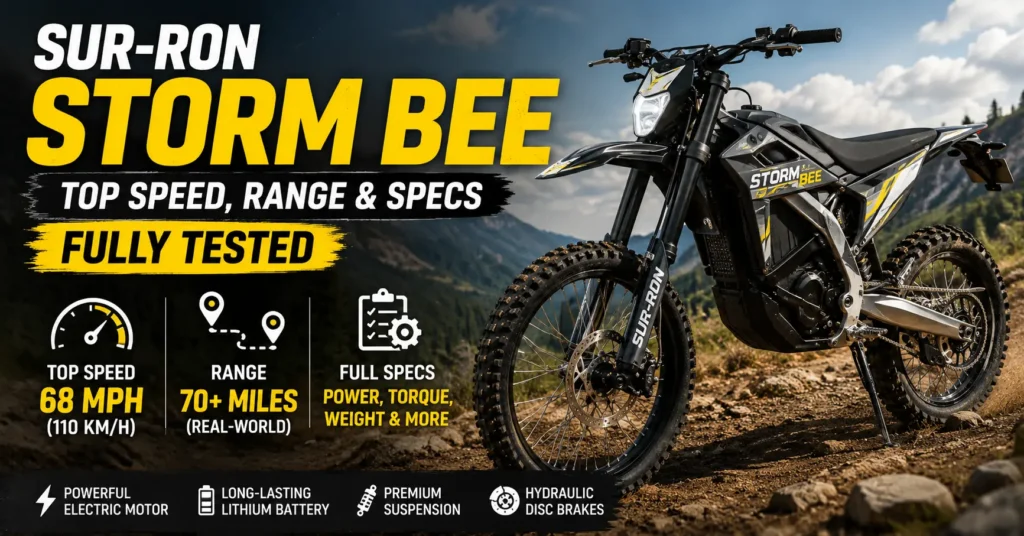
The manufacturer lists a top speed of approximately 68 mph (110 km/h) under ideal conditions. However, top speed figures rarely tell the full story.
Several factors influence real-world performance:
- Rider weight
- Terrain type
- Tire selection
- Battery charge level
- Wind resistance
- Riding mode
Most riders report reaching between 60 and 68 mph on flat terrain with a fully charged battery. The more impressive performance metric isn’t necessarily the maximum speed it’s how quickly the Storm Bee reaches that speed. Electric torque is available instantly, creating a riding experience that feels dramatically different from a gas-powered dirt bike.
0–80 km/h Acceleration Claim vs Real-World Feel
The Storm Bee is capable of accelerating from 0–80 km/h (0–50 mph) remarkably quickly thanks to its electric motor’s instant torque delivery.
In real-world riding conditions, acceleration feels:
- Immediate
- Smooth
- Predictable
- Strong through the mid-range
Unlike traditional combustion motorcycles that require clutch work and gear changes, the Storm Bee delivers seamless power from a standstill.
For trail riders, this means:
- Faster hill climbs
- Better technical section control
- Easier obstacle navigation
- Reduced rider fatigue
Many owners note that the acceleration feels stronger than the published specifications suggest because there is no delay between throttle input and power delivery.
Speed in Eco, Sport & Race Mode
The Storm Bee offers multiple riding modes that dramatically affect performance.
Eco Mode
Eco Mode prioritizes battery efficiency and smoother power delivery.
Best for:
- Trail exploration
- Beginner riders
- Long-distance rides
- Maximizing range
Top speed is limited compared to higher-performance modes.
Sport Mode
Sport Mode provides a balanced mix of power and efficiency.
Ideal for:
- Mixed-terrain riding
- Weekend trail adventures
- General off-road use
Many riders spend most of their time in Sport Mode because it offers strong acceleration without significantly impacting battery life.
Race Mode
Race Mode unlocks the bike’s maximum performance potential.
Benefits include:
- Maximum torque
- Faster throttle response
- Strongest acceleration
- Highest achievable speed
The tradeoff is increased battery consumption, which can significantly reduce riding range.
Storm Bee Range: How Far Can You Actually Ride?
Another major concern among buyers is range anxiety. The advertised range often differs significantly from real-world riding conditions. The answer depends heavily on how and where you ride.
Claimed Range vs Trail Terrain Range
Under ideal conditions, the Storm Bee can achieve approximately 70–80 miles (113–128 km) of range. However, real-world results vary considerably.
Easy Trail Riding
Typical range:
- 50–70 miles
Factors:
- Moderate speeds
- Smooth terrain
- Eco or Sport Mode usage
Aggressive Off-Road Riding
Typical range:
- 35–55 miles
Factors:
- Steep climbs
- Deep sand
- Technical trails
- Frequent acceleration
Race Mode Riding
Typical range:
- 25–45 miles
Factors:
- Maximum performance usage
- High-speed operation
- Aggressive throttle inputs
This difference explains why some owners report excellent range while others are disappointed. The riding environment matters far more than the published specification.
Battery Capacity and Charge Time Breakdown
The Storm Bee utilizes a high-capacity lithium-ion battery pack designed for high-performance riding.
Benefits include:
- Consistent power output
- Advanced Battery Management System (BMS)
- Thermal protection
- Long service life
Typical charging times:
| Charging Type | Approximate Time |
| Standard Charger | 3–4 hours |
| Partial Charge | 1–2 hours |
| Full Charge | 4 hours or less |
Battery longevity depends heavily on:
- Charging habits
- Storage temperature
- Riding style
- Maintenance practices
Most riders can expect years of reliable performance when following recommended charging guidelines.
Full Spec Table: Weight, Horsepower, Torque & Dimensions
Below is a quick overview of key Storm Bee specifications.
| Specification | Sur-Ron Storm Bee |
| Top Speed | Up to 68 mph (110 km/h) |
| Motor Type | Permanent Magnet Electric Motor |
| Peak Power | Approximately 22.5 kW |
| Horsepower Equivalent | About 30 hp |
| Torque | Approximately 520 Nm at wheel |
| Battery Type | Lithium-Ion |
| Riding Modes | Eco, Sport, Race |
| Charging Time | Around 3–4 Hours |
| Weight | Approximately 280 lbs (127 kg) |
| Front Suspension | Fully Adjustable |
| Rear Suspension | Fully Adjustable |
| Brakes | Hydraulic Disc Brakes |
| Frame | Full-Size Off-Road Chassis |
| Drive System | Chain Drive |
These specifications position the Storm Bee closer to a traditional dirt bike than many competing electric motorcycles.
Storm Bee vs Light Bee X vs Ultra Bee: Quick Comparison
Choosing between Sur-Ron’s three most popular models can be confusing.
Here’s how they compare.
| Feature | Light Bee X | Ultra Bee | Storm Bee |
| Rider Type | Beginners | Intermediate | Advanced |
| Top Speed | Lower | Moderate | Highest |
| Weight | Lightest | Mid-Weight | Heaviest |
| Power Output | Lowest | Strong | Strongest |
| Range | Good | Better | Best Overall |
| Chassis Size | Compact | Mid-Size | Full-Size |
| Off-Road Capability | Recreational | Serious Trail Riding | High-Performance Riding |
Choose the Light Bee X If:
- You want a lightweight platform.
- You ride mostly recreational trails.
- Budget is your primary concern.
Choose the Ultra Bee If:
- You want a balance of power and agility.
- You frequently ride technical terrain.
- You need versatility.
Choose the Storm Bee If:
- You want maximum power.
- You prefer a full-size motorcycle feel.
- You ride aggressively.
- You need serious off-road capability.
Who Should Buy the Storm Bee?
The Storm Bee isn’t designed for every rider.
It’s best suited for buyers who want:
Serious Off-Road Performance
If you’re regularly tackling:
- Enduro trails
- Technical terrain
- Steep climbs
- High-speed off-road routes
The Storm Bee offers significantly more capability than entry-level electric dirt bikes.
Riders Upgrading From a Light Bee
Many owners upgrade after reaching the limits of the Light Bee X.
The Storm Bee delivers:
- More power
- Better suspension
- Improved stability
- Full-size ergonomics
Riders Seeking a Gas-Bike Alternative
For riders tired of:
- Oil changes
- Air filter maintenance
- Engine rebuilds
- Fuel costs
The Storm Bee provides a compelling electric alternative.
Who Should Skip It?
The Storm Bee may not be ideal if:
- You’re a beginner rider.
- You mainly ride paved roads.
- You prioritize lightweight handling.
- You have a limited budget.
In those cases, the Ultra Bee may be a better fit.
Frequently Asked Questions
How fast does the Storm Bee go?
The Sur-Ron Storm Bee can reach approximately 68 mph (110 km/h) under ideal conditions.
What is the real-world Storm Bee range?
Most riders report between 35 and 70 miles, depending on terrain, riding mode, rider weight, and speed.
Is the Storm Bee faster than the Ultra Bee?
Yes. The Storm Bee offers higher top speed, greater power output, and stronger acceleration than the Ultra Bee.
How long does it take to charge a Storm Bee?
A full charge typically takes around 3–4 hours using the standard charger.
Is the Storm Bee street legal?
Street legality varies by state and local regulations. Buyers should verify requirements in their area before riding on public roads.
Is the Storm Bee worth buying in 2025?
For riders seeking a powerful full-size electric dirt bike with strong performance, impressive torque, and low maintenance requirements, the Storm Bee remains one of the most capable options available in 2025.
Final Verdict
The Sur-Ron Storm Bee is more than just a larger version of the Light Bee X. It represents Sur-Ron’s most capable off-road platform, combining powerful acceleration, respectable range, advanced battery technology, and full-size motorcycle ergonomics.
While it may not be the perfect choice for every rider, those seeking serious electric dirt bike performance will appreciate its blend of speed, torque, and trail-ready capability.
Ready to experience the Storm Bee for yourself? Browse our latest Storm Bee inventory and compare available models to find the right electric motorcycle for your riding style.
